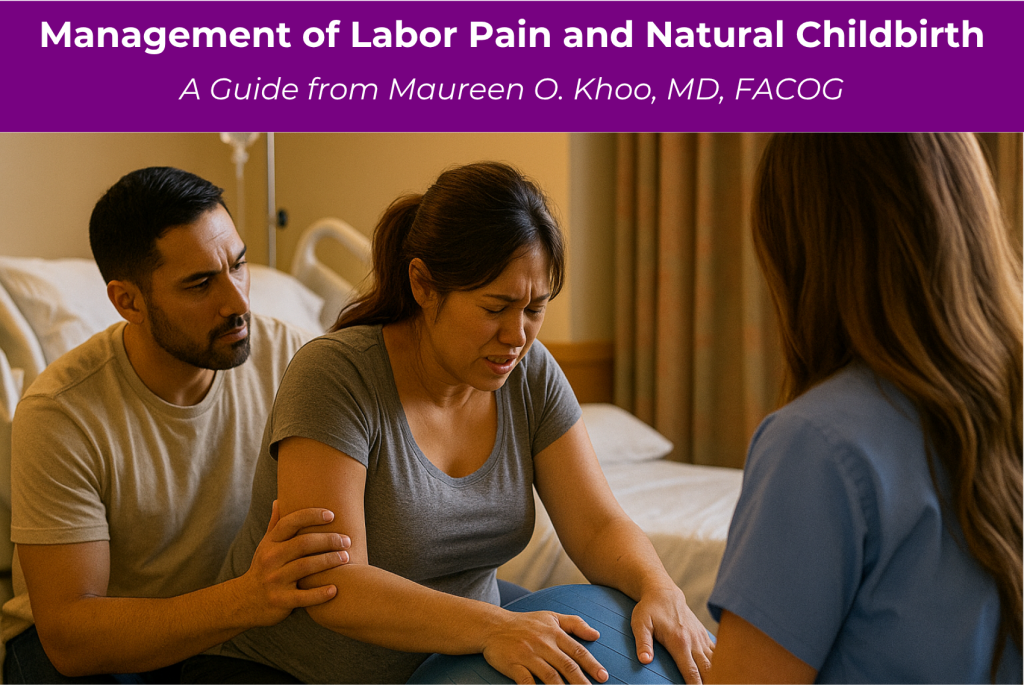
Bringing a baby into the world is powerful, emotional, and—very often—intense. Labor pain is real, but so are your options for managing it. Whether you’re hoping for a completely unmedicated birth or you simply want to minimize interventions while keeping pain under control, having a clear plan and a supportive OB-GYN makes a huge difference.
At the practice of Maureen O. Khoo, MD, FACOG, we believe:
- You deserve to understand all your options.
- You deserve to be heard and respected.
- You deserve a birth plan that balances natural approaches with safety for you and your baby.
This blog will walk you through:
- What “natural childbirth” really means
- Why labor hurts and what affects how it feels
- Safe, evidence-based natural pain management techniques
- When medications like epidurals or nitrous oxide might still be helpful
- Common questions we hear from parents-to-be
Important note: This article is for general education only and does not replace a personalized conversation with your doctor.
What Is “Natural Childbirth”?
“Natural childbirth” usually means vaginal birth without pain medications, such as an epidural or IV opioids. Some people also use it to mean “low-intervention” birth—minimal inductions, few or no medical procedures, and lots of freedom to move and choose positions.Cleveland Clinic+1
Natural childbirth often focuses on:
- Breathing techniques and relaxation
- Movement and upright positions in labor
- Supportive coaching (partner, doula, or nurse)
- Tools like water, birth balls, heat, and massage
Many patients choose a “start natural, stay flexible” approach: aiming for unmedicated labor while keeping options open for additional pain relief if needed.
Understanding Labor Pain
Every labor is different. The amount of pain you feel can depend on:NICHD
- Baby’s position
- Strength and pattern of contractions
- Speed of labor (very fast or very long labors can both be intense)
- Your previous experiences with pain
- Emotional factors—fear, anxiety, past trauma
- Support and comfort measures available
Labor pain is physiologic—it comes from strong, purposeful contractions that open your cervix and help your baby move down. Even though it’s “natural,” it can be the most intense pain many people experience.SpringerLink
The goal at Dr. Khoo’s office is not to judge your pain tolerance or your choices—it’s to help you cope and stay safe, using natural tools first whenever that’s your preference.
Natural (Non-Medication) Pain Relief Techniques
Non-pharmacologic (non-medication) methods can significantly decrease pain, lower anxiety, and sometimes reduce the need for epidurals or other drugs.Newton-Wellesley Hospital+1
Here are proven approaches we often discuss with patients:
1. Childbirth Education & Mental Preparation
Knowing what to expect can dramatically reduce fear and tension, which in turn can lessen pain.ACOG+1
Helpful tools include:
- Prenatal childbirth classes
- Reading credible, evidence-based resources
- Writing a flexible birth plan with your provider
- Practicing breathing and relaxation ahead of time
2. Continuous Labor Support (Partner or Doula)
Having continuous support from a trusted person—partner, family member, or doula—has been shown to:NICHD+1
- Decrease the need for pain medications
- Improve overall satisfaction with the birth experience
- Sometimes shorten labor and reduce cesarean risk
Your support person can:
- Offer encouragement and reassurance
- Help you change positions
- Apply massage or counterpressure
- Remind you of breathing or relaxation techniques
3. Breathing, Relaxation & Visualization
Simple techniques can help your body and mind work with contractions instead of fighting them:Newton-Wellesley Hospital+1
- Patterned breathing: Slow, deep breathing or specific patterns during contractions
- Progressive relaxation: Tense and release muscles from head to toe
- Guided imagery: Visualizing calm scenes (beach, forest, or whatever relaxes you)
- Focus points: A photo, phrase, or object you concentrate on during contractions
These don’t erase pain, but they often make it more manageable and can reduce anxiety.
4. Movement & Upright Positions
Staying mobile and upright can help labor progress and may decrease the need for epidurals.AAFP+1
Common options include:
- Walking or slow dancing with your partner
- Rocking on a birth ball
- Kneeling, hands-and-knees, or leaning over the bed
- Side-lying for rest while still keeping the pelvis open
Movement:
- Uses gravity to help baby descend
- Can ease back pain by shifting baby’s position
- Gives you a sense of control over your body
5. Hydrotherapy (Water for Comfort)
Warm water—whether in a tub or shower—can be a powerful natural pain relief tool. Hydrotherapy can:Newton-Wellesley Hospital+1
- Promote relaxation
- Decrease muscle tension
- Help you cope with contractions more comfortably
Depending on your birth setting, you may have access to:
- Labor tubs for immersion
- Showers for warm water on your back or abdomen
Dr. Khoo can discuss what your planned hospital or birth center offers and how water can fit safely into your birth plan.
6. Touch, Massage & Counterpressure
Many patients find that touch is incredibly grounding during labor. Options include:Newton-Wellesley Hospital+1
- Back massage between or during contractions
- Firm counterpressure on the lower back or hips
- Warm or cool packs on the back, neck, or forehead
These methods:
- Distract from contraction pain
- Reduce muscle tension
- Increase your feeling of support and connection
7. Techniques Like Hypnobirthing & Mind-Body Approaches
Some people prepare for natural birth with structured programs such as hypnobirthing or other mind-body techniques. Studies suggest hypnosis and similar tools may reduce the need for pain medications for some patients.AAFP+2Cleveland Clinic+2
If this interests you, mention it at your prenatal visits so Dr. Khoo can help you integrate it into your plan.
When “Natural” Does Not Mean “No Help at All”
You can absolutely value a natural, low-intervention birth and still choose or need medications at some point. Pain management exists on a spectrum.
Common medical options include:ACOG+2SpringerLink+2
1. IV or Injection Medications (Systemic Analgesia)
- Usually opioid medications given through an IV or injection
- Take the edge off pain rather than removing it completely
- Can cause some drowsiness or nausea for some people
These are often used by patients who want some relief but are not ready or do not want an epidural.AAFP+1
2. Nitrous Oxide (“Laughing Gas”)
Nitrous oxide is inhaled through a mask you hold yourself. It:Evidence Based Birth®+3American College of Nurse Midwives+3American Pregnancy Association+3
- Works quickly and wears off quickly
- Helps reduce anxiety and perception of pain, but doesn’t block it entirely
- Gives you a strong sense of control—you breathe it in only during contractions
- Has not been shown to have major negative effects on babies in studies to date
It’s less powerful than an epidural but is a good option for some parents who want a lighter, more flexible form of relief.
3. Epidural Analgesia
Epidurals are the most effective form of pain relief for labor and are widely used in the U.S.ACOG+2SpringerLink+2
An epidural:
- Provides significant pain relief from the waist down
- Allows you to stay awake and alert
- Can often be adjusted for more or less sensation
While an epidural is not “natural childbirth” by strict definition, many parents aiming for low-intervention birth still feel very empowered choosing one if labor becomes overwhelming. Choosing an epidural does not mean you’ve failed—it means you’re responding to what your body needs.
Dr. Khoo’s role is to help you understand the benefits and risks of each option and to support your decision in the moment.
Creating Your Personal Birth & Pain Management Plan
During your prenatal visits, Dr. Khoo can help you:
- Clarify your goals (unmedicated vs. “see how it goes” vs. early epidural)
- Identify which natural comfort measures appeal to you most
- Consider your medical history and pregnancy risk factors
- Discuss what your planned hospital or birth center offers (tubs, nitrous, walking monitors, etc.)
- Prepare your partner or support person with specific ways to help
We encourage you to think of your birth plan as a roadmap, not a contract. Labor can be unpredictable, and staying flexible keeps you and your baby safe while still honoring what matters most to you.
Q&A: Common Questions About Labor Pain & Natural Childbirth
Q1: Is natural childbirth safe?
For many healthy pregnancies, yes—natural childbirth can be a safe option when you’re monitored by a skilled OB-GYN and care team. Safety depends on factors like your overall health, baby’s growth, pregnancy complications, and how labor progresses.
At your visits, Dr. Khoo will review:
- Any high-risk conditions (like high blood pressure, diabetes, or prior cesarean)
- Baby’s position and growth
- Your preferences for pain relief
The priority is always a safe, healthy parent and baby—with as few interventions as reasonably possible.
Q2: How much will labor hurt?
There’s no single answer. Some people experience labor as extremely intense; others describe it more as strong pressure and waves.
Pain is influenced by:
- Contraction strength and pattern
- Baby’s position (for example, “sunny-side up” babies often cause more back pain)
- Emotional state—fear tends to heighten pain perception
- The tools and support you have availableNICHD+1
The goal of natural pain management is not to erase every sensation, but to make contractions manageable so you feel safe, supported, and in control.
Q3: Can I start with natural methods and change my mind later?
Usually, yes.
Many patients begin with:
- Breathing and relaxation
- Movement and use of a birth ball
- Hydrotherapy
- Partner or doula support
If labor becomes overwhelming or very long, it’s completely reasonable to request IV medication, nitrous oxide, or an epidural—assuming it’s still medically appropriate and timing allows.
We encourage you to tell Dr. Khoo ahead of time:
“I’d like to try to go without medication, but I’m open to it if I really need it.”
That way, everyone on your care team is prepared to support you, whatever you decide in the moment.
Q4: Will natural childbirth help me avoid a C-section?
Natural or unmedicated birth can sometimes be associated with:
- More mobility
- More upright positions
- In some cases, fewer interventions that might increase cesarean risk
However, no approach can guarantee avoiding a cesarean. C-sections are sometimes the safest choice for reasons like fetal distress, stalled labor, or complications such as placenta previa or severe preeclampsia.
The best strategy is a combination of:
- Good prenatal care
- A flexible birth plan
- A team committed to using interventions only when they’re truly beneficialACOG
Q5: What if I have a high-risk pregnancy?
If your pregnancy is high-risk (for example, due to twins, high blood pressure, diabetes, prior uterus surgery, or other conditions), certain aspects of natural childbirth may be limited, such as:
- Continuous fetal monitoring
- Restrictions on tubs or water immersion
- Earlier recommendations for epidural or other interventions
You can still use many non-medication coping tools, like breathing, massage, positioning, and labor support. Dr. Khoo will work with you to adapt natural methods within a safe, medically appropriate plan.
Q6: Can my partner really help with pain management?
Absolutely—partners are often one of the best “comfort tools” available.
Partners can:
- Remind you of breathing and relaxation
- Offer massage and counterpressure
- Help you change positions and walk
- Advocate for your preferences with the care team (with your permission)
We encourage partners to attend prenatal visits and childbirth classes when possible, so everyone is on the same page about your pain management plan.
Q7: How should I prepare in the third trimester?
A few practical steps:
- Take a childbirth class that covers natural pain relief techniques
- Practice breathing and relaxation at home
- Write a flexible birth plan and review it with Dr. Khoo
- Pack a “comfort bag” for the hospital:
- Birth ball (if not provided)
- Headphones / playlist
- Essential oils (if allowed)
- Heating pad (if allowed)
- Massage tools or tennis balls
- Birth ball (if not provided)
- Discuss your preferences with your support person so they know how to help
The more prepared you are, the more confident and calm you’re likely to feel when labor begins.ACOG+2Cleveland Clinic+2
Q8: What if my birth doesn’t go “according to plan”?
Birth is unpredictable, and that is not a reflection of your strength or commitment.
Maybe you planned an unmedicated birth but chose an epidural. Maybe you hoped to avoid a C-section but ended up needing one. None of that takes away from the fact that you gave birth.
At follow-up visits, Dr. Khoo is always happy to:
- Talk through what happened
- Answer lingering questions
- Help you emotionally process your experience
- Discuss what it means for any future pregnancies
Your experience and feelings matter, not just the clinical outcome.
Ready to Talk About Your Birth Plan?
If you’re pregnant or planning to be, and you’d like a thoughtful, evidence-based discussion about natural childbirth and labor pain management, we’d be honored to care for you.
📍 Los Gatos Office
Address:
320 Dardanelli Lane, Ste 20
Los Gatos, CA 95032
Phone: (408) 364-2440
📍 Mountain View Office
Address:
2490 Hospital Drive, Ste 209
Melchor Pavilion
Mountain View, CA 94040
Phone: (408) 364-2440
🖥️ Visit our website or call us to book your appointment today!
Together, you and Dr. Maureen O. Khoo can create a birth plan that honors your wish for a natural experience while keeping safety, flexibility, and compassion at the center of your care.